


U.S. business logistics costs hit $2.58 trillion in 2024 — 8.8% of the nation’s entire GDP — and the pressure isn’t letting up in 2026. Rising tariffs, nearshoring shifts, e-commerce surges, and climate-driven disruptions are compounding the challenge every quarter.
But here’s what most logistics leaders misdiagnose: the cost crisis isn’t an execution problem. It’s a decision-intelligence problem. Your Transportation Management System (TMS) dutifully records every delay, every demand spike, every routing inefficiency — after it happens. What it doesn’t do is tell you what to do before those failures compound into cost overruns.
That’s the gap AI-powered logistics software was built to close. And in 2026, closing that gap is the difference between logistics as a cost center and logistics as a margin driver.
Why Traditional TMS Falls Short in 2026?
A traditional TMS is a record-keeping and execution tool. It tracks shipments, audits freight invoices, and logs carrier performance. These are important functions — but they answer the wrong question. They tell you what happened. In 2026’s volatile logistics environment, what you need to know is what to do next.
Four compounding pressures expose this gap most sharply:
- Demand Volatility: Seasonal spikes, e-commerce surges, and geopolitical disruptions — from Red Sea rerouting to new tariff regimes — routinely outpace monthly planning cycles. By the time a TMS registers the shift, the window for cost-efficient response has closed.
- Fragmented Data: ERP, TMS, and WMS systems operate in silos, surfacing insights that are days old. Routing decisions made on stale data are, at best, suboptimal — and at worst, they trigger expensive expediting.
- Escalating Costs: Fuel surcharges, distribution center labor scarcity, and inventory carrying costs up 13.2% year-over-year are squeezing margins from multiple directions simultaneously.
- Invisible OTIF Failures: Without AI operating at the SKU and route level, poor product positioning and suboptimal carrier selection remain invisible until they surface as missed delivery windows or emergency shipments.
McKinsey estimates that AI applied to the logistics decision layer can reduce logistics costs by 5–20% and inventory by 20–30%. But that ROI only materializes when AI is driving decisions — not when it’s overlaid on the same broken data flows your TMS already produces.

What AI-Powered Logistics Software Actually Does?
AI-powered logistics and transportation management software like ThroughPut operates above the TMS layer — not as a replacement, but as the intelligence layer that makes your existing systems actionable in real time.
The core distinction: ThroughPut doesn’t rerun planning models when conditions change. It recommends targeted corrective actions based on what is physically happening in your network right now. This minimizes internal process volatility — the same principle behind Toyota’s Kaizen philosophy, applied to supply chain decision-making.
Four live indicators power every recommendation:
- Changing Lead Times
Flags supplier and carrier delays before they cascade into stockouts or expedites.
- Demand Signal Shifts
Captures demand surges proactively, enabling reallocation before capacity constraints hit.
- Operational Backlogs
Identifies and prioritizes bottlenecks before they spill over into delivery failures.
- Predicted Disruptions
Models the financial impact of tariffs, weather events, cyberattacks, and carrier capacity constraints before they materialize.
Together, these four inputs give ThroughPut a network-wide view that no single planning system — or planning team — can replicate manually.
How ThroughPut Works: No Migration, No Rip-and-Replace?
The most common objection to any new logistics technology is implementation complexity. ThroughPut was built to eliminate that barrier. It connects to your existing ERP, TMS, WMS, MES, and 3PL carrier APIs — resolving timestamp mismatches and siloed data structures — to create a single, unified decision point. No ETL overhaul. No extended stabilization period.
The process runs in four phases:
- Ingest: Pull structured and unstructured data from existing ERP, TMS, WMS, MES, and carrier systems without requiring a migration.
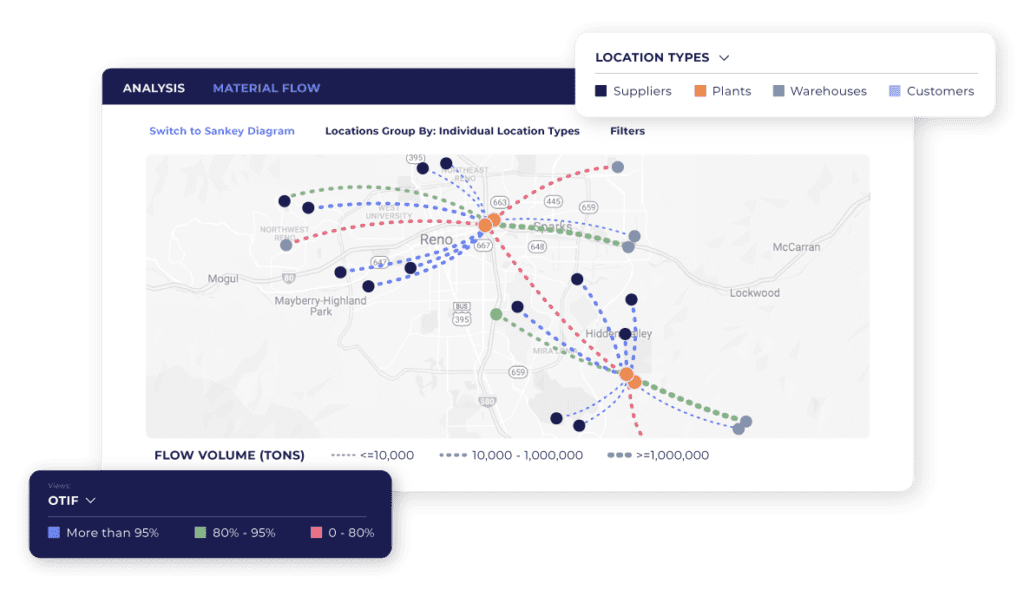
- Analyze: Map material flows, demand signals, lead times, and cost structures across your full network — surfacing hidden leaks like underutilized freight lanes or unnecessary DC-to-DC transfers.
- Prescribe: Deliver ranked corrective actions by financial impact and operational urgency — not a new plan, but a precise list of interventions.
- Optimize: Run continuously as conditions evolve, not once per planning cycle.
Most enterprise clients reach their first optimization insights within 8–12 weeks, with ROI measured against auditable baseline data from Day One — not after the 12-month stabilization period typical of legacy platform replacements.
Real-World Results: What This Looks Like in Practice
The business case for AI-powered logistics software isn’t theoretical. Here’s what ThroughPut customers have achieved:
| Customer | Challenge | Outcomes |
| North America’s Largest Transit Authority | Service disruptions, workforce shortages, traditional operations model | Fleet availability up; working capital reduced; schedule reliability restored |
| Leading European Retail Chain | Rising DC-to-DC costs, poor OTIF, siloed distribution data | €3.5M annual logistics cost savings 33% transport cost reduction 90%+ OTIF delivery rate Up to €10M bottom-line impact per facility |
| Global Port Operator | Low demand segmentation frequency, lost sales, insufficient cross-selling visibility | ~$2M revenue potential identified 50+ lost customers recovered Scenario-based forecasting for financial impact modeling |
2026 Logistics Trends: Why AI Is No Longer Optional?
The logistics landscape in 2026 is defined by a convergence of pressures that legacy TMS platforms were never designed to handle simultaneously:
- Tariff volatility from ongoing U.S.-China and U.S.-Mexico trade realignments is forcing constant carrier and routing reoptimization.
- Nearshoring acceleration is restructuring North American distribution networks faster than manual planning cycles can adapt.
- Cyberattack frequency targeting logistics infrastructure has increased significantly, requiring predictive contingency modeling.
- E-commerce volume growth continues to demand sub-24-hour fulfillment windows at scale.
- Climate-related disruptions — port closures, extreme weather, flood-driven road closures — are no longer rare tail risks; they are recurring planning inputs.
AI/ML integration is now the defining characteristic of best-in-class TMS platforms — not as an add-on, but as the core intelligence layer. The shift from reactive to proactive logistics management isn’t a trend; it’s the new baseline for competitive operations.
Frequently Asked Questions
Question: What is the difference between a TMS and AI-powered logistics software?
Answer: A traditional TMS manages and records transportation execution: carrier selection, freight tracking, rate auditing. AI-powered logistics software operates above it — analyzing demand signals, predicting constraints, and prescribing ranked corrective actions before service failures occur. A TMS tells you what happened. AI-powered logistics software tells you what to do next.
Question: How do I reduce logistics costs without replacing my TMS?
Answer: By adding an intelligence layer on top of it. ThroughPut connects to your existing TMS, ERP, and WMS systems — without replacing any of them — and surfaces cost reduction opportunities those systems cannot identify on their own: unnecessary DC-to-DC transfers, suboptimal carrier allocation, reactive expediting from inaccurate forecasts, and underutilized freight lanes. McKinsey estimates AI at the logistics decision layer delivers 5–20% cost reductions. ThroughPut customers have achieved 33%.
Question: How long does implementation take, and when does ROI begin?
Answer: Most enterprise clients reach first optimization insights within 8–12 weeks. ROI is measured against auditable baseline data from Day One — not after a 12-month stabilization period. ThroughPut eliminates the integration bottleneck that delays traditional platform deployments by resolving timestamp mismatches and siloed data structures across your existing systems.
Question: Does ThroughPut replace my ERP, TMS, or WMS?
Answer: No. ThroughPut connects to your existing ERP, TMS, and WMS infrastructure. Your current systems stay intact. ThroughPut creates a single decision point across all of them.
Ready to turn logistics into a margin driver?
ThroughPut’s AI logistics intelligence layer connects to your existing systems in weeks — not months — and delivers measurable ROI against auditable baselines from Day One. No TMS replacement required.
