
How ThroughPut AI’s Decision Intelligence Enhances Pricing & Promotion Strategies in the F&B Industry?


Here’s the thing about the Food & Beverages (F&B) industry: Pricing your products isn’t just about covering costs and achieving target profits. It’s also about staying competitive and retaining loyal customers in a market that is always in flux.
Your products have a shorter shelf life. Demands fluctuate wildly. Customer preferences vary widely. Market conditions are continually evolving.
In such a dynamic environment, a fixed pricing strategy simply won’t suffice.
This is where dynamic pricing and promotion come into play.
For instance, products nearing expiration need quick turnover, and seasonal changes can drastically alter the availability and cost of ingredients, thus affecting prices.
However, implementing dynamic pricing is a complex endeavor.
It requires a delicate balance of internal factors like inventory levels and cost of goods with external factors such as market trends and competitor pricing.
Traditional methods such as managing these variables through multiple spreadsheets or disparate software systems, often lead to delayed or inaccurate data, resulting in poor pricing decisions that can detrimentally impact your business.
Fortunately, new technologies like AI and machine learning offer promising solutions to overhaul how pricing and promotions are managed in the F&B industry.
In the following sections, we’ll explore the pricing and promotion challenges in the F&B industry that need to be immediately tackled, delve into how platforms like ThroughPut AI can assist, and guide you on how to get started.

Pricing and Promotion Challenges in the F&B Industry
Pricing and promotion are so complex in this industry that manual efforts fail to capture and respond to the many nuances. Here are some of those nuances that turn into challenges that companies most struggle with:
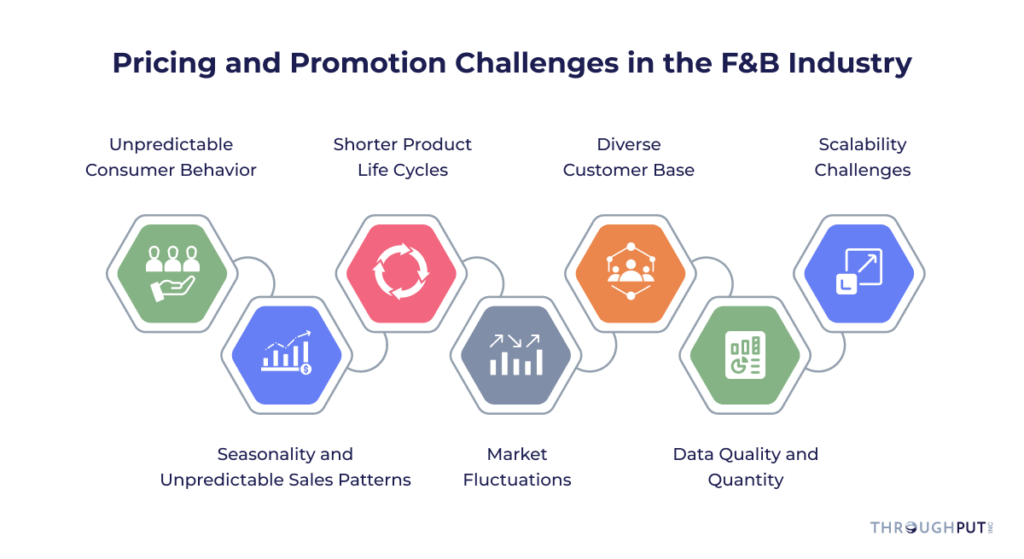
- Unpredictable Consumer Behavior: Consumer tastes and preferences can shift rapidly influenced by trends, health concerns, and social media. These changes can abruptly alter the demand for specific products making it difficult to maintain optimal pricing and promotional tactics.
- Seasonality and Unpredictable Sales Patterns: Many F&B products are subject to seasonal demand fluctuations such as increased ice cream sales in summer or higher demand for certain beverages during holidays. These patterns require dynamic pricing strategies to maximize profits during peak times and minimize losses during off-peak seasons.
- Shorter Product Life Cycles: The quick turnover of products especially in categories like snacks and drinks forces companies to continuously innovate and frequently adjust their marketing and pricing strategies to stay relevant in a competitive market.
- Market Fluctuations: Economic conditions, changes in commodity prices, and shifts in consumer spending power can all influence market dynamics. These fluctuations demand agile pricing strategies that can quickly adapt to new market conditions.
- Diverse Customer Base: The F&B sector serves a wide array of demographics, each with different purchasing powers, tastes, and preferences. Tailoring pricing and promotions to effectively target these varied groups without alienating others is a complex task that requires sophisticated market segmentation techniques.
- Data Quality and Quantity: Effective pricing and promotional strategies are heavily reliant on high-quality, comprehensive data. Many businesses struggle with collecting, analyzing, and leveraging the right data to make informed decisions, leading to suboptimal pricing and lost revenue opportunities.
- Scalability Challenges: As F&B companies expand, they must scale their pricing and promotion strategies across different regions, cultures, and customer segments. This scalability often poses significant operational challenges, especially when trying to maintain consistency in brand messaging and pricing fairness across diverse markets.
Addressing these challenges requires a combination of advanced analytical tools, strategic planning, and continuous adaptation to changing market conditions. Businesses that can effectively navigate these complexities are better positioned to optimize their pricing and promotional strategies, enhancing both profitability and market share.
What Constitutes Effective Pricing and Promotion Strategies in the F&B Industry?
Effective pricing and promotion strategies in the F&B industry increasingly rely on analytics and AI to dynamically adjust pricing and promotional efforts.
Here are four critical components of any robust pricing and promotion strategy:
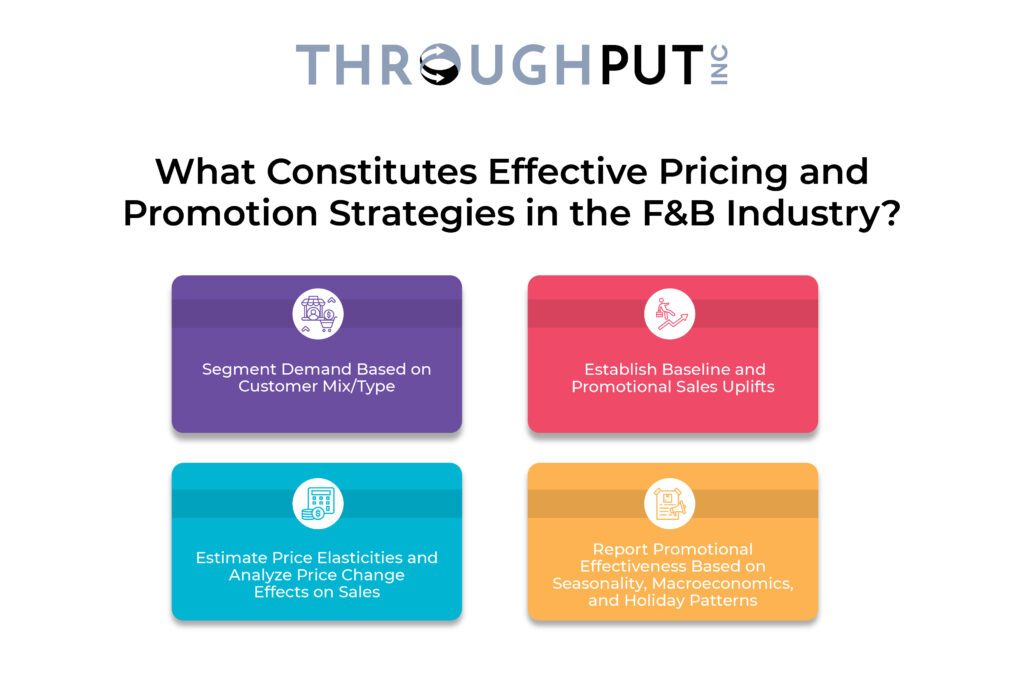
Segment Demand Based on Customer Mix/Type
Utilize existing data points to segment demand at a global level by customer mix/type.
This involves analyzing customer demographics, purchasing behaviors, preferences, and regional trends among multiple other variables to create segments that will inform your pricing and promotion strategies.
For instance, pricing can be adjusted to appeal to budget-conscious consumers during economic downturns, or premium prices can be set for gourmet enthusiasts who value high-quality ingredients. This strategic pricing helps maximize revenue across different customer segments.
Establish Baseline and Promotional Sales Uplifts
Establish a baseline of normal sales performance across various customer types or segments globally, without the influence of promotions.
This analysis involves identifying patterns and differences in purchasing behaviors, demographics, and other distinguishing factors among customer groups.
Establishing a baseline is essential for assessing the impact of promotions, as deviations from this baseline during promotional periods indicate the ‘sales uplift’ attributable to those specific marketing activities.
This insight will allow you to tailor your promotional strategies more effectively, targeting the right customer segments with the right promotions to optimize sales outcomes.
Estimate Price Elasticities and Analyze Price Change Effects on Sales
Understand how sensitive customers are to price changes, a concept known as price elasticity of demand.
By analyzing historical sales data against different price points, while controlling for external variables like market trends or competitor actions, you can gauge the responsiveness of sales volumes to changes in pricing.
Knowing whether a product’s sales are highly elastic or inelastic will help you in crafting more effective pricing strategies.
For instance, a product with high elasticity would likely see a significant increase in sales from a price reduction, potentially offsetting the lower price point through increased volume, thereby maximizing revenue.
Report Promotional Effectiveness Based on Seasonality, Macroeconomics, and Holiday Patterns
Evaluate the effectiveness of promotions by correlating their outcomes with seasonal trends, economic conditions, and specific holiday periods.
By analyzing how different promotions perform under various circumstances, you can identify which are most profitable and under what conditions. This enables better planning of promotional activities to ensure they are timed and executed to coincide with periods of high profitability, such as major holidays or during economic upswings, thereby optimizing the impact and ROI of marketing investments.
This strategic alignment will help you prioritize high-return promotions and adjust marketing tactics to align with consumer behavior and economic cycles.
Accurate Pricing and Promotion Strategies for the F&B Industry by ThroughPut AI
ThroughPut AI employs real-time decision intelligence to enhance pricing and promotion strategies in the F&B industry. It simple terms, it accurately predicts near-term demand and optimizes pricing and promotional tactics in real-time to maximize profitability.
Let’s break that down a little further and see how the tool enables pricing and promotion:
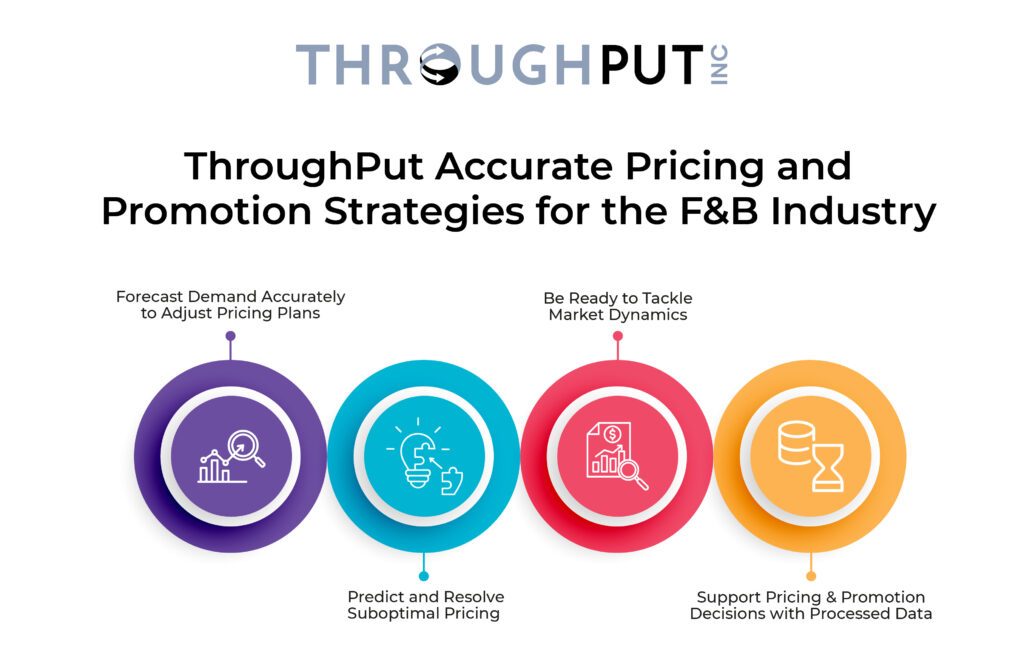
Forecast Demand Accurately to Adjust Pricing Plans
With ThroughPut AI, you can leverage advanced analytics to accurately forecast demand and optimally adjust your pricing strategies. This tool empowers you to dynamically tailor your pricing based on real-time market data, helping you attract more customers and maximize your ROI.
By understanding and reacting to consumer demand shifts promptly, you ensure your pricing remains competitive and aligned with current market conditions.
Predict and Resolve Suboptimal Pricing
Move beyond traditional pricing limitations by replacing legacy systems with cutting-edge analytics. This transition allows you to track business performance and apply complete, accurate datasets to anticipate demand accurately.
With ThroughPut AI, you can proactively adjust your pricing, ensuring that your strategies are both effective and adaptive to market changes, thus eliminating suboptimal pricing practices.
Be Ready to Tackle Market Dynamics
ThroughPut AI provides real-time data insights that keep you well-informed about current and future market trends. This capability allows you to manage volatile inventory levels effectively with relevant ABC/XYZ segmentation, ensuring that you are always ready to respond to market dynamics.
ThroughPut AI helps you maintain precise control over your inventory, reducing risks associated with overstocking or stockouts, and enhancing your overall market responsiveness.
Support Pricing & Promotion Decisions with Processed Data
Rely on the tool’s comprehensive data-backed analytics to make informed decisions that could significantly influence your business’s trajectory. This powerful tool processes and analyzes vast amounts of data, offering you the insights needed to make strategic pricing and promotional decisions.
With ThroughPut AI, you gain the confidence to navigate complex decision-making scenarios, identify growth opportunities, and drive innovation in your market strategies.
With these capabilities, you can expect to see the following benefits:
- Safe Price Adjustments Across Multiple Product Categories: Strategically implement price cuts or increases, ensuring they align with consumer demand and market conditions.
- Evaluate the Impact of Various Promotions and Discounts on Key SKUs: By systematically ranking these promotional activities based on their effectiveness and performance, you gain valuable insights that help optimize your marketing efforts.
- Drive Profitable Growth: Leverage AI-powered price sensitivity scores, to not only enhance revenue potential but also ensure that your pricing decisions are data-driven and aligned with evolving market dynamics, maximizing your competitive edge.
How to Get Started With ThroughPut AI’s Pricing and Promotion Intelligence
Getting started with ThroughPut AI is straightforward. Even if you choose another solution, we recommend this approach as a dependable way to begin using analytics and AI for pricing and promotion.
It does not have to be a lengthy process or involve the entire business in one go.
You can start small, in an iterative manner, and then scale up.
This is how to get started:
- Find an executive sponsor, board member, or C-suite executive (operations and finance background preferred) who understands the importance of customer segmentation for the supply chain and the business
- Start with a pilot first. Pick a distribution center or production line to provide material flow-related data.
- No initial IT support required. Work with existing data and infrastructure to see initial ROI in less than 90 days.

Advanced-Level FAQ for “Pricing and Promotion Strategies for F&B”
Question 1. How can AI-driven pricing improve margins across multi-SKU, short-shelf-life F&B portfolios?
Answer: AI identifies price elasticity at the SKU level, correlating it with inventory age, seasonality, regional behaviors, and competitor dynamics.
For executives managing thousands of SKUs, this means the system automatically recommends price increases, markdowns, or promotions based on near-term demand signals—not past averages.
This leads to faster stock rotation, fewer expiries, improved margin control, and reduced waste.
Question 2. What measurable ROI can COOs and CFOs expect from implementing AI-led pricing and promotion intelligence?
Answer: Most F&B companies observe ROI within 60–90 days when AI optimizes promotions, eliminates pricing leakages, and aligns price decisions with real-time demand.
ROI typically stems from:
- 8–15% reduction in expired or slow-moving inventory
- 5–12% increase in uplift from high-performing promotions
- 3–10% improved margin contribution from optimized price elasticity
ThroughPut AI accelerates ROI because it uses your existing data infrastructure, requiring no heavy IT lift.
Question 3. How does AI prevent revenue loss from over-discounting or poorly timed promotions?
Answer: AI models identify which promotions actually drive uplift, which are margin negative, and which cannibalize other SKUs.
It aligns promotions with real-time demand conditions such as:
- Near-expiry inventory
- Seasonal surges
- Macroeconomic trends
- Regional buying patterns
This prevents blanket discounts and ensures promotions only run when they maximize profitability—not just sales volume.
Question 4. Can AI optimize pricing when market volatility (commodity costs, supply shocks) is high?
Answer: Yes. AI continuously evaluates macroeconomic, supplier, operational, and demand-side variables.
When raw material prices change, demand shifts, or competitors adjust pricing, AI dynamically recalibrates optimal price points.
This helps executives sustain margins without compromising competitiveness—critical in volatile commodity categories like dairy, grains, beverages, and packaged goods.
Question 5. How does ThroughPut AI integrate pricing strategies with inventory, production, and supply chain conditions?
Answer: Executive leaders often struggle because pricing teams and supply chain teams work on separate data systems.
ThroughPut AI unifies:
- Inventory aging
- ABC/XYZ segmentation
- Production constraints
- DC-level demand signals
- Supplier variability
The platform ensures pricing decisions reflect real operational capacity—not just marketing assumptions.
Question 6. How does AI ensure compliance and pricing fairness across multiple regions and channels?
Answer: AI standardizes pricing logic so leadership can enforce consistent rules across geographies, distributors, and retail channels.
It automatically flags price inconsistencies, identifies margin leaks, and recommends channel-specific strategies while still respecting regulatory and brand guidelines.
Question 7. What type of data is required to start with AI-driven pricing and promotion optimization?
Answer: F&B companies can get started with:
- Historical sales data
- SKU inventory details
- Regional/branch-level transactions
- Promotion calendars
- Production/inbound supply data (optional but helpful)
No new IT systems are needed. ThroughPut AI works using existing ERP/WMS/MES data and produces insights in <90 days.
Question 8. How do executives ensure data security and governance when using AI for pricing?
Answer: ThroughPut AI maintains enterprise-grade data security, encryption, and access control layers.
Data never leaves secure environments, and role-based access ensures that only assigned leaders can view sensitive pricing models.
Audit trails ensure executive oversight over every pricing change.
Question 9. How does AI help solve challenges around operational bottlenecks caused by poor pricing or promotions?
Answer: Poorly planned promotions can overload production, create SKU imbalances, or cause stockouts.
ThroughPut AI highlights:
- Which promotions will create operational bottlenecks
- Which SKUs may face shortages
- Which plants/DCs lack capacity for upcoming demand surges
Executives can then align production and distribution with demand-ready pricing strategies.
Question 10. How fast can a COO or CFO see value after adopting AI-based pricing and promotion?
Answer: Most enterprise clients see initial impact in 6–12 weeks, including:
- Reduction in waste
- Improved pricing accuracy
- Better promotion ROI
- Higher throughput and demand fulfillment
Because ThroughPut AI doesn’t require new IT infrastructure, adoption is quick and non-disruptive.
Question 11. How does AI help leaders build resilience against supply chain disruptions affecting pricing?
Answer: AI simulates pricing scenarios based on real-time risk factors such as:
- Supplier delays
- Ingredient shortages
- Demand spikes
- Logistics constraints
- Market volatility
It recommends price changes that maintain profitability while sustaining availability across key regions.
Question 12. How can AI support C-suite strategic decision-making for long-term pricing models?
Answer: AI generates board-level intelligence:
- Contribution margin forecasting
- Long-term elasticity models
- Optimized annual pricing plans
- Strategic SKU rationalization
- Profitability and demand outlooks
This ensures leadership can make multi-year pricing decisions backed by real data—not manual assumptions.

