Differences Between Demand Planning and Demand Forecasting (Complete Guide for 2026)

In today’s volatile and data-driven supply chain environment, understanding the difference between demand planning and demand forecasting is no longer optional—it’s a competitive necessity.
Many organizations still use these terms interchangeably. However, this confusion leads to:
- Poor inventory decisions
- Increased stockouts or overstock
- Inefficient production planning
- Reduced service levels (OTIF)
- Revenue leakage
For supply chain leaders, operations managers, and procurement heads evaluating AI demand planning software, getting this distinction right is critical for making high-impact decisions.
This guide breaks down:
- What demand forecasting is
- What demand planning is
- Key differences (with real-world examples)
- Why both are required (not optional)
- How AI-powered demand planning software transforms outcomes
What is Demand Forecasting in Supply Chain?
Demand forecasting is the process of predicting future customer demand using historical data, statistical models, and external signals.
What Does Demand Forecasting Answer?
- How much will customers buy?
- When will demand occur?
- Which products will see demand fluctuations?
How Does Demand Forecasting Work?
Modern demand forecasting uses:
- Historical sales data
- Seasonality trends
- Promotions & campaigns
- Market intelligence
- External data (weather, economic signals)
- Machine learning algorithms
Traditional forecasting relied heavily on spreadsheets and static models. Today, AI demand forecasting software uses:
- Predictive analytics
- Probabilistic forecasting
- Pattern recognition
- Continuous learning models
Why is Demand Forecasting Important?
Accurate demand forecasting helps businesses:
- Reduce forecast errors
- Improve inventory positioning
- Minimize stockouts
- Plan production efficiently
- Support financial forecasting
However, forecasting alone does not drive execution. That’s where demand planning comes in.
What is Demand Planning?
Demand planning is the strategic process of aligning supply chain operations with forecasted demand.
It transforms predictions into actionable execution plans across the organization.
What Does Demand Planning Answer?
- How do we fulfill forecasted demand?
- How much inventory should we hold?
- What production capacity is required?
- How should procurement be aligned?
What Does Demand Planning Include?
Demand planning goes beyond forecasting by integrating:
- Inventory planning
- Production planning
- Procurement strategies
- Sales & Operations Planning (S&OP)
- Scenario planning & risk mitigation
Why Demand Planning Matters for Enterprises?
Without demand planning:
- Forecasts remain theoretical
- Operations become reactive
- Inventory costs increase
- Service levels drop
With advanced AI demand planning software, organizations can:
- Improve responsiveness to disruptions
- Simulate multiple scenarios
- Optimize inventory dynamically
- Align cross-functional teams
What are the Differences Between Demand Planning and Demand Forecasting?
The difference between demand planning and demand forecasting is that they serve different roles within the supply chain. Demand forecasting focuses on the ‘what’ and ‘how much,’ while demand planning addresses the ‘how’ by integrating the forecast with business planning processes.
Demand planning is about creating a plan that meets forecasted demand and maximizes efficiency and profitability.
In contrast, demand forecasting is a more narrowly defined process that depends on predicting future demand. It serves as a critical input for demand planning but needs to encompass the broader strategic elements.
Demand planning and forecasting are not mutually exclusive; they are complementary processes that, when combined, form a powerful duo for supply chain management.
Demand Planning vs Demand Forecasting: A Quick Comparison
| Feature | Demand Forecasting | Demand Planning |
| Purpose | Predict future demand | Align operations to meet that demand |
| Scope | Analytical, data-driven | Strategic, cross-functional |
| Time Horizon | Short- to long-term | Short-term and real-time tactical decisions |
| Methods Used | Historical data, ML, regression | Forecast + human judgment + scenario planning |
| Output | Quantitative forecasts | Actionable supply chain decisions |
| Ownership | Data science / analytics team | Supply chain / operations team |
| Technology Used | AI demand forecasting models | Demand planning software, S&OP platforms |
Why Both Are Needed (Not One or the Other)
Demand forecasting and planning are not competing concepts.
They are complementary.
Forecasting gives you the signal.
Planning turns it into action.
When combined effectively:
- production becomes stable
- inventory costs drop
- margins improve
- operational risk decreases
- stockouts & overstock shrink
- OTIF performance improves
- procurement becomes smarter
This is why modern supply chains are shifting toward:
- Real-time planning
- Probabilistic forecasts
- AI-driven sensing
- Supply chain digital twin capabilities
What are the Benefits of Combining Demand Planning and Demand Forecasting
The benefits of combining demand planning and demand forecasting are improved inventory management, simplified operations and increased efficiency of the supply chain.
Not to forget, the business profitability that comes from more controlled and planned supply chain operations.
The strategic advantage of integrating demand planning and forecasting lies in the synergy they create. Combining forecasting’s predictive power with demand planning’s strategic framework enables businesses to create robust, forward-looking plans grounded in reality.
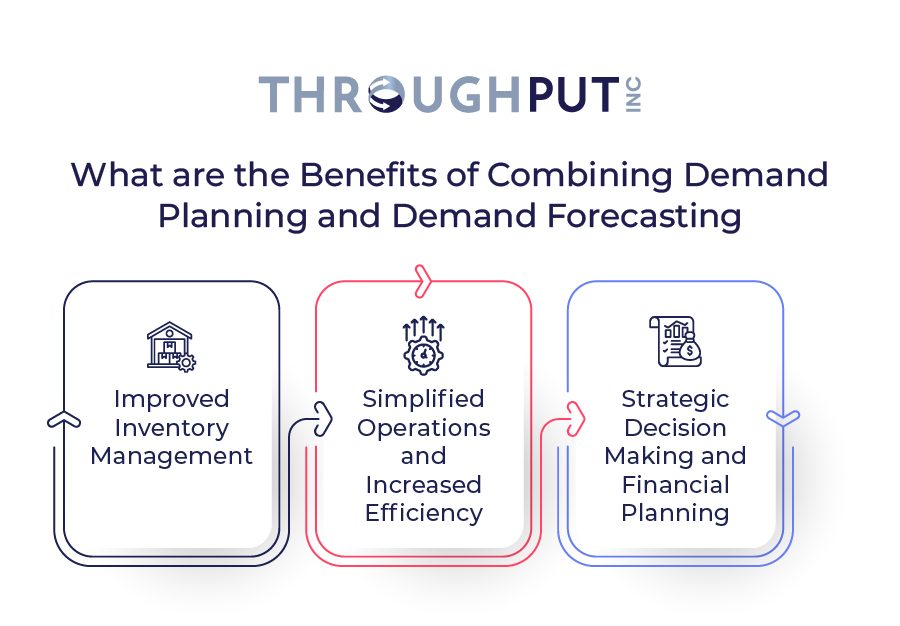
1. Improved Inventory Management
One of the main advantages of combining demand planning with demand forecasting is the notable enhancement in inventory management. When demand planning utilizes the predictive insights from demand forecasting, companies can determine the ideal inventory levels with better precision.
This collaboration prevents the costly drawbacks of having excessive inventory, which can tie up funds and increase storage expenses, as well as inadequate inventory, which can result in missed sales opportunities and customer dissatisfaction.
2. Simplified Operations and Increased Efficiency
The fusion of demand planning and forecasting enables businesses to simplify their operations. With a clearer understanding of future demand, companies can schedule production runs, manage labor requirements, and coordinate logistics more efficiently, leading to improved operational efficiency.
This integration ensures that resources are allocated to where they are most needed, reducing wastage and enhancing the overall flexibility of the supply chain.
3. Strategic Decision Making and Financial Planning
Combining demand planning with forecasting also supports strategic decision making and financial planning.
Accurate forecasts provide demand planners with valuable information, enabling them to make more informed decisions regarding marketing strategies, financial investments, and resource allocation.
What are Real-life Examples of Demand Planning and Demand Forecasting?
Great real-life examples of demand planning and forecasting are Amazon, Zara and Coca-Cola.
Successful demand planning and forecasting can be seen in companies that consistently meet or exceed customer expectations while maintaining optimal inventory levels and operational efficiency.
These companies use forecasting techniques and strategic planning to respond swiftly to market changes, capitalize on opportunities, and mitigate risks.
Here’s a short breakdown of each example:
Example 1: How Does Amazon Use Demand Forecasting?
Amazon operates one of the most complex supply chains in the world, dealing with millions of products and a vast customer base.
Amazon uses sophisticated demand forecasting algorithms incorporating machine learning to predict customer demand. These algorithms analyze historical sales data, customer search trends, and external factors such as seasonality and promotions.
Implementing these advanced forecasting methods has allowed Amazon to optimize its inventory levels, reduce stockouts, and improve delivery times, contributing to its reputation for fast and reliable service.
Example 2: How Does Zara Combine Planning and Forecasting?
Zara, a fast-fashion retailer, operates in an industry where trends change rapidly, and the ability to respond quickly to consumer preferences is crucial.
Zara uses a combination of demand forecasting and demand planning to manage its supply chain. They collect data from store sales and customer feedback to forecast demand for different clothing items.
Their vertically integrated supply chain allows for quick adjustments to production based on these forecasts.
Zara’s approach has resulted in a highly responsive supply chain that can bring new designs from concept to store shelves in weeks, aligning inventory with current fashion trends and reducing markdowns.
Example 3: How Does Coca-Cola Use Demand Sensing?
Coca-Cola must respond quickly to changes in consumer demand across various markets and product lines.
Coca-Cola uses demand sensing AI tools that leverage near real-time data from point-of-sale systems, social media, and weather forecasts to adjust its demand forecasts daily or weekly.
This approach has enabled Coca-Cola to be more agile in its supply chain operations, responding promptly to sudden changes in demand and minimizing waste from unsold products.
What is AI Demand Planning Software and Why Does It Matter?
Modern supply chains are moving beyond traditional tools toward AI-powered demand planning and forecasting software.
What Makes AI Demand Planning Different?
AI-driven platforms provide:
- Real-time demand sensing (0–30 days visibility)
- Probabilistic forecasts (not single-point predictions)
- Scenario simulation (what-if analysis)
- Automated recommendations
- Continuous learning models
How ThroughPut AI Transforms Demand Planning and Forecasting
ThroughPut AI introduces a next-generation approach using:
Demand Sensing Capabilities
- Combines historical + real-time data
- Uses AI to detect short-term demand shifts
- Improves forecast accuracy significantly
Actionable Planning Recommendations
Unlike traditional tools, it provides:
- What to produce
- When to produce
- Where to allocate inventory
Fast Implementation
- Integrates with existing systems
- Delivers results within one fiscal quarter
- Scales across industries
Digital Twin Capability
- Simulates supply chain scenarios
- Helps optimize decisions before execution
This makes it one of the best demand planning software solutions for enterprises evaluating AI-driven supply chain optimization.
How to Choose the Best Demand Planning Software
If you’re evaluating solutions, here’s a buyer checklist:
Must-Have Capabilities
- AI/ML-based forecasting
- Real-time demand sensing
- Scenario planning
- Inventory optimization
- S&OP integration
- ERP integration
Key Questions to Ask Vendors
- How quickly can we see ROI?
- Does it support real-time data?
- Can it simulate disruptions?
- Does it provide actionable insights or just dashboards?
- Is it scalable across business units?
Final Conclusion: Demand Planning vs Forecasting
Understanding the difference between demand planning and demand forecasting is critical for building a resilient, data-driven supply chain.
Key Takeaways
- Forecasting predicts demand
- Planning executes against it
- Both are essential—not optional
Organizations that integrate both with AI-powered demand planning software achieve:
- Stronger competitive advantage
- Higher efficiency
- Lower costs
- Better service levels
FAQ:
Question: What is the main difference between demand planning and demand forecasting?
Answer: Demand forecasting predicts future demand, while demand planning aligns operations to meet that demand.
Question: Can demand planning exist without forecasting?
Answer: No. Forecasting is the foundational input required for effective demand planning.
Question: Why is AI important in demand forecasting?
Answer: AI improves forecast accuracy by analyzing large datasets, identifying patterns, and adapting to real-time changes.
Question: What is demand sensing in supply chains?
Answer: Demand sensing uses real-time data (0–30 days) to adjust forecasts dynamically and improve responsiveness.
Question: What is the best demand planning software for enterprises?
Answer: The best demand planning software includes AI-driven platforms like ThroughPut AI that combine forecasting, planning, and execution insights.
Question: How does demand planning improve inventory management?
Answer: It ensures optimal stock levels, reduces excess inventory, and prevents stockouts through better alignment with demand.
Question: How quickly can businesses see ROI from AI demand planning tools?
Answer: Most companies see measurable improvements within one fiscal quarter.